Dressing-Up for Shul

  * This humour essay was published in snippets on the Huffington Post, and full on Shtetl Montreal, a radio show and website with fun, new-Jew twists.


Dressing-Up for Shul: A nostalgia essay


______________________________________________________________

When I was a kid, my mom — a converted shiksa with blond hair and a southern drawl — would have me and my sister Alana model our synagogue best, from orange gingham jumpers to plaid blue kilts with white turtle necks, weeks before the Jewish high-holidays. If the clothes didn’t fit, she’d scour the shops for new ones. She wanted us to look “appropriate” for synagogue, as she called it.

A woman of details, mommy would also inspect our white stockings for runs and make sure our black and white saddle shoes were polished. Then she’d also take us to get our red hair freshly trimmed into bowl cuts, and have the beautician scrape all the specks of dirt from beneath our fingernails.

I assumed that mommy was so obsessed with us looking appropriate because she looked and sounded so different from the other women at our modern Orthodox shul (‘synagogue’ in Yiddish) in Montreal, where the congregation just stopped short of traditions like top hats and wigs.

Continue reading

Fascinators gaining popularity

Awesome photo courtesy of www.ladydianehats.com. 

An article all about the increased popularity of hats, with a nod out to Kate Middleton and Johnny Depp (yep, I just put them in the same sentence!), plus an explanation as to why hats went out of style around the ’60s. It has as much to do with our hairdos as it does the rejection of stuffy old norm. *This article appeared in the Montreal Gazette and online at the Telegraph Journal Canada East.

Kate Middleton is fascinated by fascinators, small headpieces adorned with jewels, tulle, flowers and most importantly, feathers. Her playful headdress has helped morph the otherwise conservative dresser into a sharpshooting fashionista, especially when paired with those body-con dresses. When announcing her engagement, Middleton wore a saucer-like number by milliner Vivien Sheriff. To recent formal occasions, she has sported teeny fascinators with wild feathers, and even glamorous wide-brimmed versions. They were all poised delicately on the side of her head, right on top of her brow, like a perpetual wink.

Fascinators latch on with either combs or clips. They are intended to have a weightless, hovering look. 

Of course, Middleton won’t be wearing a fascinator on Friday, the day of her wedding, even though veil fascinators are popular choices among brides these days. Rather, she will likely be wearing an heirloom tiara from the royal collection, which is a traditional royal wedding gift.

No doubt, Middleton’s stylish entourage will be sporting fancy and wild-looking headpieces for the occasion, including the ever-popular fascinators. In England, hats are as significant as dresses in such enchanted circles – and nowadays, for Top Shop shoppers, as well.

To celebrate the royal wedding in Canada, stores are even stocking up on the British fascinator. Mind you, they’re slightly tamer, less pricey versions. They also typically fit on as headbands, not as clips. But those decorative feathers are still propped up high to the sky.

“People are buying headbands just to watch the royal wedding on TV and to run through the streets. Headbands with feathers!” says an amazed Corine Serruya, a lively dame who sells hats all over the world from her Ophelie Hats factory on Jean Talon Street in Montreal. She has supplied many stores with the same high-flying numbers, which are to be sold as paraphernalia in celebration of the royal wedding. “So many boutiques in Toronto wanted to make sure they’ll have them for their customers. I couldn’t believe it.”

Serruya says that she was raised in France, which might explain her disbelief about all the monarchy madness. “People are really attracted to the royalty. It’s genuine love,” she now understands.

Serruya’s factory boasts a metal hat-blocking machine, which allows her to stamp out hats in about seven minutes (the traditional technique requires pulling material over wooden blocks, which can take more than half an hour). Because of her stamper, Serruya’s retail costs are low, ranging from about $60 to $160 per hat. This formula, along with her constant need to take risks with her designs, has allowed the feisty businesswoman to distribute hats all over the world including to Harrods in London, Le Bon Marché in Paris, Takashimaya in Japan and Holt Renfrew in Montreal.

“Each market is totally different,” she says. For example, Spanish girls love casual headpieces called “tocados.”

“They’re small, colourful and with sequins. And they have to look happy,” she said. In Jamaica, things are quite the opposite. “Women are very proper,” she said, opting for black hats for church or daytime wear. Women in France are not huge hat buyers, but when they do purchase them, they either go really small or “they go big,” she says, motioning toward an oversized glamorama fan hat, in black. It was see-through, and utterly stunning. “They can’t really kiss anyone when they wear it,” she laughs. She says Japanese women love hats, and generally opt for small, hip styles.

In Montreal and Canada, hat markets are notoriously inconsistent, if not non-existent – excluding toques, which are ideal for keeping warm. But she says, like the younger set in Britain, more and more twentysomethings are wearing hats with their outfits. But instead of clipping on outlandish fascinators, they typically cover up with fedoras, trapper hats and otherwise masculine styles.

“After the 1940s and 1950s, women just stopped wearing (hats),” she said. Previously, women wore hats to church, for a stroll, and just about everywhere. Then, times of change and revolution turned the once adored chapeau into a symbol of constraint, she said. Today, Serruya says that aside from religious dress, getting a 35- to 55-year-old to wear a hat is near impossible because of this negative connotation.

Lucie Gregoire is a Montreal milliner who crafts custom-made hats using the old, wooden-block technique. She has a strikingly similar observation about why hats fell out of favour. “It was about liberation,” she says. Gregoire points out that after hats were outmoded, hairdressers took over. “Now women don’t want to wear a hat on top of their $150 colouring job,” she said. “Hats do flatten your hair; I can’t pretend they don’t,” she said. Plus, they can present a basic mechanical constraint. Driving with a hat can be a challenge, for example.

For the royal wedding, Gregoire is making a custom hat for Sharon Johnston, the wife of David Johnston, governor-general of Canada. She says it will take three fittings to make the hat perfect for face and outfit (usually it’s only one hat fitting that Gregoire requires). Gregoire also once made a fedora for Johnny Depp to wear in the movie Secret Window, along with a matching hat for John Turturro.

Gregoire regularly teaches regular beginner workshops in her studio for groups of three to five students (French only). So while she knows first-hand how riveted people can be by hats, she also knows just how difficult it is to get a woman to wear one, let alone finding one that looks just right.

“In French, there’s an expression, ‘I don’t have a head for hats,'” she said. “But if I didn’t have the opportunity to try on so many, I’d say the same.” She said stores often only carry the same styles and sizes, which aren’t right for everyone. Hats are typically a question of proportion – do you have a big face or a small face, a large or small head? These issues can determine how big the brim should be and how high the top of the hat should be, for example. “The same woman can look horrible with the brim pointed down, but if you lift it up, it changes everything,” she said. This is why women should try on as many styles as possible before making sweeping conclusions about whether or not they look good in hats.

If a woman still refuses, she’s probably just nervous about sticking out in her hat. “People believe they are being watched more than they are,” she said.

And regardless of this jittery 35 to 55 age group, Gregoire again echoes Serruya in declaring that “hats are back” – especially among the younger generations. She says CEGEP-age students come to her studio and try on a mini-fedora backward or totally cocked to the side (her ready-to-wear hats cost about $75, whKate-Middleton-Fascinators-Hair-Accessoriesile her custom hats range from $200 to $400). “Now (hats) are all about fashion,” she said, instead of about being proper. But in choosing small hats, women still obviously care a great deal about their hair.

“Hats are becoming very important,” says Avi Tenzer, design director for Aldo Group. “Before, we just had one or two (hats). But, now, accessories are booming.” Tenzer explains that the economic downturn led to an increased interest in accessories, particularly among younger generations. Accessories generally cost less, and more importantly, they can also spruce up an otherwise bargain outfit. “You might buy skinny jeans and flip-flops, but add on tribal necklace or earrings, and you have a look,” he said, noting that every week in the Aldo accessories division, sales are on average 20 per cent above expectations at stores in Canada, the U.S. and Britain.

Hats especially give that “final touch” to one’s style, Tenzer said. And like the hat-wearing Depp, style nowadays is all about creating your own personal signature – for women and men.

“Young kids today mix rockabilly with punk with grunge” he said. Meanwhile, back in his day, everyone was “a victim,” copying the star of the moment, whether it was Duran Duran or Boy George. Hats are an ideal way to update and mix traditions.

“I think they’re going to be even bigger,” Tenzer said of hats. And by bigger, he likely means more in numbers. While Indiana Jones-style hats are a trend, and a woman might whip out a wide-brimmed sun hat on occasion, like Depp’s fedora and Middleton’s fascinator, it’s still the smaller numbers that work with our precious ‘dos.

Bodysuits Are Back!

*The article below appeared in the Montreal Gazette and then in-print or online at the Vancouver Sun, the Calgary Herald, The Province, The Times Colonist and others.

_______________________________________________________________

“Oh jeez, please no!” is likely what most women think when hearing the word “bodysuit.”

But it’s time to, er, suck it up: The form-fitting, snap-crotch bodysuit is gaining some major retail momentum. By summer, expect to see the look at more stores than just American Apparel.

This season, a navy blue bodysuit sold out across Canada at Club Monaco in less than a month. “Some things just fly off the racks,” said a baffled sales clerk, pulling out a purple bodysuit instead. The purple version with jersey swooping around varies from the bestselling blue, which had long sleeves and was in silk.

Continue reading

The Art of the Window Display

This is a kind of holiday-inspired story I wrote, even though window dressers work all year round. It was fascinating to learn was just how artistically driven these crafty workers can be and also how utterly detailed oriented the whole process is. Here’s a gasp-worthy display from Bergdorf’s from the limited-edition book by Tashen, followed by my article.

From new limited-edition book “Windows at Bergdorf Goodman” released by Assouline. A Compendium of Curiosities III: Illogical Lexicons and Convivial Characters, Holiday 2009. With Jay Soonthornsawad. Fabricated entirely in paper. Sculpture by Biak Kerdkan, Matt Northridge, and James Vance. Inspired by “Alice” books by Lewis Carroll.

* This article originally appeared in the Montreal Gazette and online versions in the Calgary Herald, the Star Pheonix, the Windsor Star and on Canada.com.

“Window Wonderland” 

Take the imagination of Dali and swirl it into the colour sensibility of Klimt. Then pour the mixture into a curvy mould clad in lingerie, and pop on 24 heads. Only then will you be halfway able to grasp the macabre and magnificence required to dress the windows at Bergdorf Goodman on Fifth Ave. in New York.

“Minimalism is great. Maximalism, too. What we avoid is mediumism,” writes David Hoey, senior director of visual presentation at Bergdorf’s, in the preface of Windows at Bergdorf Goodman, recently released by Assouline. This mother of all

coffee table books (it costs $560) catalogues the awe-inspiring storefront windows created by Hoey and Linda Fargo, senior vice-president of fashion office and store presentation. Displays include two giant polar bears in a wrestling ring, a wedge wearing tightrope walker and a series of enchanted forests, razzle dazzle assemblages inspired by Lewis Carroll’s “Alice” books.

Bergdorf’s elaborately themed window spaces, which span the block between 57th and 58th Sts., are changed almost weekly, revealing a shocking rebirth of imagination. Each space is about four metres high and a mere 1.2 metres deep.

Whether to attract the attention of fast-paced denizens in Manhattan or to please the savvy shoppers of Montreal, window displays are a spectator’s delight. Especially in late November and December, when store owners treat shoppers to the nostalgia of Christmas lights mixed with innovative whimsy.

Continue reading

A men’s fashion trilogy, new Americana


*This article first appeared in the Montreal Gazette, and then went viral online at Canadian Postmedia newspapers including the Vancouver Sun, Calgary Herald, Edmonton Journal, etc.


Here’s a little something for the fellas. This fall I was inspired by the new Americana or Heritage look for men and wrote about it on three separate occasions (one’s on ties, another on man bags, and the last is a Q&A with two store owners). I think it’s a great, cozy style, esp. when pulled off correctly!

These mini articles are different from the long, feature stories I typically post on this website — which, btw, is a forum to showcase my work, not to reprint every single article I write in the earnest ambitions of getting sued! (If you wanna read my shorter articles on a regular basis, please Google!!). Thanks for understanding, kind reader.

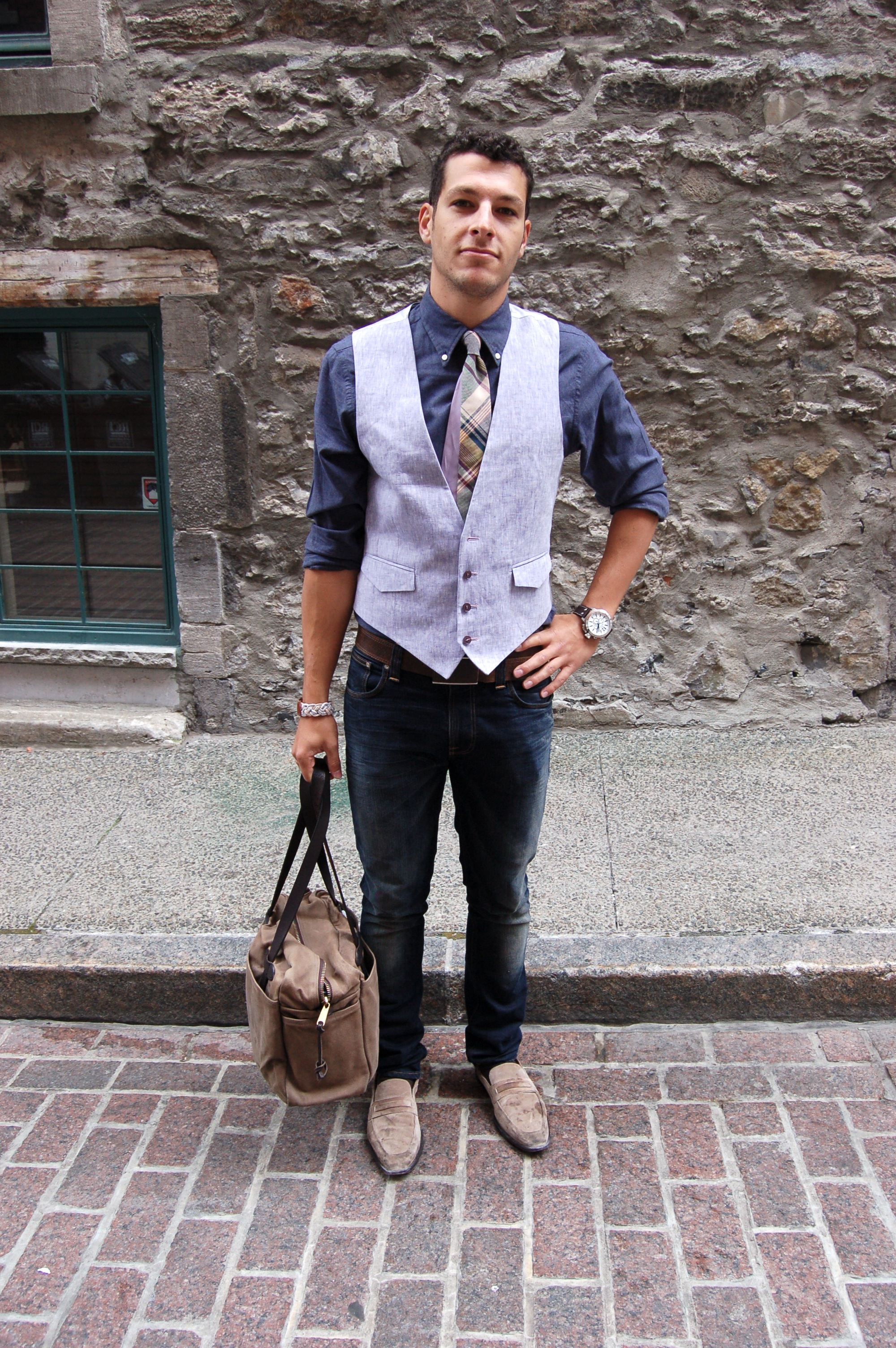
It’s Dave’s cousin Gilad (hence the giant photo)! He’s modeling for new online tie company Dolbeau.ca. Note the man-bag too, which is article #2 in this man fashion article trio.
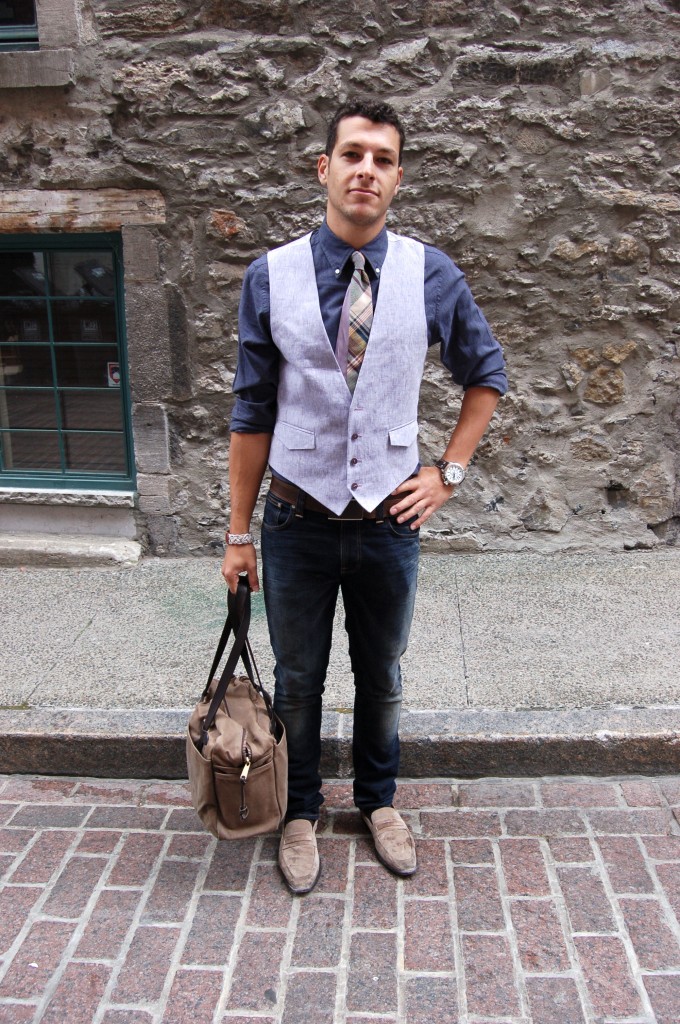
MEN OF TIES, Part 1 of new Americana Men’s Fashion

A slightly dishevelled dapper look is all the rage these days in menswear, according to David Caplan and David Gross.

Citing what’s in this fall, the founders of Dolbeau.ca, a new online custom neckwear company based in Montreal, say keep the jeans and button down, throw on a cozy sweater or blazer, but add a personalized flare -say a floral themed bow tie or perhaps a plaid woolly skinny tie.

“In Montreal, it’s not usual yet, but in Toronto bow ties are becoming more popular,” says Caplan, sporting a bow tie himself. “I wear it everywhere,” he says.

“In Scandinavia and Italy, they’re popular also,” says Gross, wearing one of his custom designed solid ties.

Gross was inspired to launch Dolbeau.ca, named after his grandmother’s street in Outremont, after reading men’s fashion blogs like valetmag.com, getkempt.com, streetpeeper.com and thesartortialist.blogspot.com. He says these blogs, not the runway shows, are dictating fashion today.

“Men are looking for special accessories,” Gross says, and the “workingman Americana” look is the prominent style.

“Bow ties or ties are a great way of expressing yourself and standing out,” he adds.

To keep the look unique, all Dolbeau.caties are custom made.

They’re sewn here in Montreal with the fabric imported from such countries as Germany, Italy, France and the United States.

Customers choose their own two-tone pattern, width, tip and tie length (shorter for petite fellows and longer for taller gents or those with large necks).

“We’re catering to people who know their own taste,” Gross says. “It’s a one of a kind piece for a one of a kind person.”

Custom ties are $119, and bow ties are $89, both plus tax in Quebec, and available for purchase on Dolbeau.ca.

A customized line by boutique Rooney, which includes solid-coloured narrow wool ties and diamond tip bow ties, is available at Rooney on 395 Notre Dame St. W. in Old Montreal and rooneyshop.com.

Lookbook
One of the Dolbeau.ca founders David Caplan.


Man Bags All The Rage, Part 2 of New Americana Men’s Fashion

Scott (the Sartorialist) Schuman helped to raise the mystique of WANT Les Essentiels de la Vie bags, founded by Montrealers Dexter and Byron Peart, by last year featuring the brand in the SartoriaLUST pop-up shop at Barneys New York. These days, men of all types, not just street-style photographers, are coveting a good bag to lug around their gadgets.

“Men are constantly travelling with smart phones, iPads, iPods, keys, wallets, pens, passports, etc.,” Dexter Peart said. “There’s a legitimate need for small bags that offer the same function as a lady’s purse, (but) something that retains a certain masculinity.”

So call it a man bag, a “murse” or even just a bag. Just make sure it serves several purposes.

According to the Peart bothers, their O’Hare tote, which comes in leather or organic cotton, is a hit because it has a minimalist design and can be used for multiple purposes.

Still, they agree that most men need four bags: a computer bag, a shoulder bag/ knapsack, an overnight bag and a tote.

“We try to create products that adapt to the contrasting environment that we live in,” Byron Peart said.

Filson%20ori%20briefcase%20tan%20front
A Filson briefcase from ronneyshop.com. See interview below.


Q&A with owners of Boutique Rooney

Alex Danino and Michelle Golfman, who are husband and wife, own Rooney, a men’s and women’s clothing boutique at 395 Notre Dame St. W. in Old Montreal. Next to the shop’s ever-fashionable women’s tops and sweaters, there is a “well curated” assortment of Americana men’s fashion. 514-543-6234. www.rooneyshop.com.

How did you come up with the store’s concept -or, first of all, what would you call the store’s concept?

Alex: Well, it’s a unisex store, and, at this moment, it’s probably split 60 per cent on the men’s side and 40 per cent on the women’s. It’s becoming a bit more of a lifestyle shop, too, with a variety of interesting things that all go toward the same aesthetic, really, be it through books or accessories or whatever. But you asked what the concept is, right?

Yep.

Alex: Well, the aesthetic is my own personal evolution. Initially when we opened the store (five years ago), it was more of a streetwear –

Michelle: Younger.

Alex: Yeah, younger and the commodities were a bit more affordable. There were more T-shirts, hoodies, button-downs and denim. Footwear was more on the sneaker side. Then I turned 30 and then I was sort of like, ‘you know what? I want to get into more of a mature feel.’

So, how are the clothes different now?

Alex: I got into more formal footwear, more like an Oxford-style. And then the brands that I was personally starting to be passionate about, a lot of them are starting to manufacture in North America or sourcing fabrics from Italy and Portugal, so the prices went up, too. But that’s not every product -there’s a real mix. I don’t want button-downs to be above $200. We try to make it affordable. We even have button-downs starting at $70.

I see a lot of plaid button-downs here. How is a $200 plaid shirt here different than one, say, at H&M for about $20?

Alex: Well, you know, they cut corners. They offer a product for really, really cheap and they save money because they need to cut corners somewhere.

Michelle: And they sell to mass.

Alex: Yeah, and so there are two things. You end up with a product that’s not going to last you and then you end up with a product that maybe every one of your friends is going to be in. Although the second part might not be as important, I think the first part is because you’ll end up with a product that will probably fall apart.

And how long should a plaid shirt from here last?

Alex: Well, I mean, hopefully, maybe 10 years, maybe more. And a lot of these products get better with age. Like some of the fabrics they’re using are wax cottons, canvas, denim -and they age well. They get these patinas when you wear them. If you have a wallet in a certain position or if you have something always there like keys, you have your own personal wear, which is kind of cool.

So, it’s a preppy, over-30, worn patina look -is that the style you’re now selling?

Alex: I guess you could call preppy, or you could call it Americana or even Canadiana, like local stuff that’s made in the U.S. or Canada. Also, there’s a resurgence in heritage brands that have actually been around for over 100 years, like woollen products from Pendleton and Woolrich. Then there’s Filson and Red Wing boots that still make the same products. The overall aesthetic is influencing a lot of the new designers, too.

How does a guy wear these heritage products in a modern style, though? Like, right there I see plaid flannel shirt. I mean, what do you call that style of plaid again?

Alex: Blanket check.

Right. So, on the mannequin you’ve put a blanket check button-down shirt, with a tie and an over-sweater: What’s that look about?

Alex: It’s the prints, the patterns, the fabrics that are blended together. It’s not just a white shirt with a black blazer and a black tie. This is texture, which is cool. Because there’s like flannel with a pattern and then the thicker woolly texture. And then you have a tie with its own really interesting weave. So, together you’ve got more of an outdoorsy feel as opposed to something that, say, a banker or an accountant might wear.

Where would a guy wear that kind of outfit?

Alex: To be honest, anywhere and always. I see a guy walking out of his house, you know, or if you’re working in a creative field from marketing to advertising to an Internet company. And it’s cool to see because it’s been a good response. People even younger than guys in their 30s are taking this kind of trend into their lives. Guys as young as high school.

We even sell this book that was a reissue from the 1960s.

I see: Take Ivy, by Teruyoshi Hayashida.

Alex: Yeah, it was made in 1965 by a Japanese photographer and all these images are Ivy League campuses in the ’60s and the fashion is exactly the same today. The things they’re wearing (points to a picture of check Bermuda shorts) are exactly what I sold this summer. It’s really kind of interesting how it’s come full circle, though in more slightly updated ways.

What are some of those updates?

Alex: They’re less boxy. They’re a little more tailored and fitted. But they’ll still have some of the original features like box pleats in a shirt, or button-down collars, but at the same time more of a modern fit.

What do you think is responsible for the resurgence in this style of men’s fashion?

Alex: Good question. Obviously, it’s always been around with J. Crew and things. But now it’s become more popular starting about 31/2 years ago, where you started getting a lot of blogs who are interested in these products, and really going after these old brands. And then it started trickling into the designers.

Michelle: And then there are TV shows like Mad Men and people are wanting to bring that back.

Alex: Yeah. And even now on Boardwalk Empire they dress amazingly; all the clothing’s phenomenal.

Do your customers buy separate pieces or the entire look?

Alex: Overall, it’s the whole aesthetic, the whole package that you see all together. Like some guy in Australia bought a pair of Bass shoes on our online shop, which is an old company that’s easy to find, but it was just packaged on my website. So this guy got a blazer from Our Legacy, a pair of shoes from Bass, I think maybe a book also.

What’s your average customer like?

Alex: Anywhere from 20 to 40. There’s a good section of tourists who come through and then there are a lot of locals. We also have people coming back from Toronto and New York who go on these foodie-type trips.

So your heritage clothes are on the upswing with local gourmand cuisine?

Alex: Yeah, except sadly, there aren’t a lot of Montreal or Canadiana heritage brands. We carry Naked and Famous from Montreal, who do quite well –

Michelle: Otherwise, there’s a mixture of American, Swedish, British …

You’ve described your store as “well-curated” before. What do you mean by that?

Alex: That I take an obscene amount of time to research some of the products. It’s all I do and I love doing it. So, it’s really my passion. I spend all day long looking at products, blogs, seeing what people are doing out there. I look at everything.

Michelle: And all night. All day, all night -it’s true.

Alex: We always focus on the quality of the product, and backstory is important. I want to tell customers where the product is from, who the designer is, so they can walk away knowing what they just bought.

Michelle: It’s that or H&M. Alex: And guys want product. They want product that can last, that are made by hand. That’s what this store is about. It’s not to say that China doesn’t make good product -we sell product made in China, they’re known for knit and they have some of the best machinery -it’s just that the English mill worker has history. They’ve been doing it for 150 years. Wax cotton is part of their tradition. If you wanna get the best product, you have to ask ‘where is it from?’ and ‘where did it originate?’

Social Photography 101 and the SELFIE; Becoming Master of your iPhoto Domain is all about Planned Casualness

How to pose for the oh-so-casual selfie?

098

Hair up with whispers of a come-hither look?…. OR

100
… Hair down and a pearly white, off-kilter smile?

As you can see from my webpage photo, I tend to prefer the sultry look. Regardless, since it took me a zillion tries to even get those semi-decent photos, I think I should practice my casual pic pose a little more!

*The article below appeared, in full or in part, in The Montreal Gazette, The Vancouver Sun, Edmonton Journal, and The Province.

Social Photography 101

The camera doesn’t love me. It doesn’t quite loathe me, either. Occasionally, it warms up to my crooked nose and zigzag smile. But based on the law of averages, I can safely predict that I’d rather see most shots taken of me disappear into the vast digital universe where they came from.

Unfortunately, they often pop up on someone else’s Flickr photo montage or Facebook page. But I’m trying to get over it. Online photo albums and social networking sites are flourishing, and embedded cameras on cellphones, iPhones and computers give millions of new photo diarists endless opportunities to showcase their skill.

And true, the skill can get ugly. Much like most new art forms, social photography — photographs intended to be shared with a large network of people — is one that beats to the most unusual sensibility. Formalities like posing or centring the shot become extraneous. Rather, it’s all about documenting your own real-time narrative, and you don’t even need a third party to help you do it.

According to a recent article in the New York Times, all you need to do is to reach out your arm, aim somewhere around your nose and snap, flash or click! You’ve got a perfectly acceptable self-portrait, aka “Selfie”, to post online. An instructional online slide show running with the piece explained that these shots should look fun and slightly off-kilter. And, like the self-portrait artist Cindy Sherman, funny costumes are welcome, too.

Whether it’s a wonky selfie, or you posting a few action shots of your pals, photography this millennium is certainly not what it used to be. But, like everything else that looks effortlessly cool, major preparation is often involved.

Continue reading

Flash sales blow up

Thanks to a tip from a friend, the outnet.com is one of my favorite new flash sale websites. Even though the labels are exclusive, the site doesn’t insist upon that “members only” policy. The above patterned dresses by Pucci, Matthew Williamson, and Erdem (respectively), were all available for a very limited time on the website at over 60% to 70% off.

*This article appeared orignally in the Montreal Gazette and on the Canada.com network.

At a large warehouse in St. Laurent, in a newly crafted photo studio, Alisa Pysaryeva, a model from Folio agency, strikes a pose in a Whitney Eve dress. A few doors down in another studio, a mint green Balenciaga handbag is being puffed and positioned for its photo op. Luxury handbags are lined up, awaiting their turns.

Photo shoots like these happen daily at Beyond the Rack, a Montreal company that sells discount Gucci, Juicy Couture and lesser-known brand-name items at online “flash sales.” A flash sale means that bargain items -typically last season’s overstock and sample pieces reduced in price by 40 to 70 per cent -are available only for a brief, limited time.

For Beyond the Rack’s shoppers, that’s a mere 36 hours after the sale opens at 11 a.m., when a mass emailing alerts customers to the latest deals -like the Balenciaga bag going for $1,599 instead of the original $2,095. Buyers then act fast. Not only will the company’s million-plus customers be vying for the same discount items, but when the time’s up, the “flash sale” is extinguished.

88879_in_l76478_in_l70513_in_l

Far beyond Beyond the Rack -indeed, over the border and across the sea -similar flash sale websites are scorching through the Internet. Popular sites, all ending with a . com, include Gilt Groupe, Haute-Look, Vente Privee, RueLaLa, Enviius, Ideeli and Fashion Vault (eBay’s latest attempt get into the game). Each has its own photo studios, models and designer labels, and each insists that its customers are really “private members”-that is, to get daily emails about these flash sales, shoppers must be invited to join the website by a friend, or request a membership online.

Even if practically everyone who signs up for most of these sites is accepted, it’s a tactic that helps turn potential waste into a desirable commodity.

“Like a bouncer with velvet ropes, you’ve got to create a fence, a barrier around these clearance items,” says Beyond the Rack CEO Yona Shtern.

Continue reading

Dress Like an Olympian

And she wins the silver! Here the amazing Jennifer Heil is wearing her pre-Olympics Columbia Sportswear attire.

*This article appeared, in full or in part, in The Vancouver Sun, The Montreal Gazette, The Ottawa Citizen, Calgary Herald, Edmonton Journal, The Province, Times Colonist, the Leader Post.

Athletic wear is not exactly considered high-style. That being said, as you swish down the hill under the chairlift or swivel around Beaver Lake, looking as cute as possible may have an uncanny effect on your sporting skills.

Continue reading

It’s a Hi/Lo Holiday

Balenciaga

Basic Balenciaga Arena City purse from Holt Renfrew, over $1500 ( *This article was featured in The Montreal Gazette.) 

Some shoppers prefer to buy generic. They’ll take discount clothing and no-name groceries over fancy logos on cars, bikes, furniture, and even ibuprofen (a.k.a. Advil): To them, brand names mean nothing.

Equally devout are those who’ve got sparkling insignias on their Prada sunglasses, Lexus cars and Apple computers. They believe top quality is something you can see and touch – and it’s always worth the extra splurge. Somewhere in between the two camps are the dreamers: the gal who lusts after a $28 Chanel nail polish (while a Personelle polish costs $3.99), and the man who wishes a brand new flat-screen TV for $2,099 would appear under the tree even though an older model costs $299.

So, what products are worth the splurge? Which ones make better steals?

Here’s a breakdown of popular gift items that can come with generic or luxury price tags.

Continue reading

Looking Good in Green

THE-GAZETTE

Weekend Life cover, Montreal Gazette.

*This article also appeared, in full or in part, in The National Post, The Ottawa Citizen, The Calgary Herald, The Windsor Star, The Leader Post, The Star Phoenix and in industry blogs like ecofashionworld.com and payitforward.org.

It’s vegan, eco-friendly, fair-trade, made locally – and proceeds help impoverished children! The latest do-gooder fashion companies are certainly setting some high standards.

Toms Shoes, based in Santa Monica, Calif., is giving away a pair of shoes to a needy child for every pair purchased. British giant Marks and Spencer has adopted a mission – “Plan A” – to become carbon neutral and to stop sending waste to landfills by 2012.

Meanwhile, Paris’s yearly Ethical Fashion Show, a trade event featuring conferences, workshops and runway shows centred on ecological and social matters, is touring cities such as New York, Rio de Janeiro, Berlin and Milan through next year.

The sustainable-fashion movement is blowing up like a big green balloon, with innovative companies finally adding corporate responsibility to the bottom line.

Problem is, as a consumer, after you try on those perfect-fitting jeans, in the 30 seconds it takes to walk to the cash register, it’s nearly impossible to start weighing ecological matters such as water waste and land use, or ethical matters, such as labour conditions and charity causes.

“Most people get overwhelmed and turn it off,” said Lindsay Coulter, a.k.a. the Queen of Green for the David Suzuki Foundation.

Continue reading